Engaged Media
Patient Insight Platform

TL;DR Engaged Media aimed to help pharmaceutical companies understand treatment effectiveness through branded patient surveys. As the sole Product & UX Designer, I defined the product foundation — translating complex healthcare data requirements into an intuitive, privacy-compliant platform that enabled structured data collection while protecting patient identity.
Project Overview
Engaged Media was a healthcare startup building a platform that allowed pharmaceutical companies and healthcare providers to collect patient-reported outcomes through branded surveys. The goal was to measure treatment efficacy by aggregating patient experiences into usable, compliant insights.
The challenge was balancing data accessibility with strict privacy requirements, ensuring sensitive patient information remained protected while enabling meaningful analysis across stakeholders.
Role
Sole Product & UX Designer
Responsibilities
User research & stakeholder interviews
Information architecture (IA)
User flows & journey mapping
Sketching & wireframing
Interaction design & prototyping strategy
The Problem
Pharmaceutical companies lacked a scalable way to understand how treatments performed in real-world conditions.
They needed a holistic view of patient treatment outcomes, including:
Dosage and treatment duration
Medication adherence
Comorbidities and hereditary factors
Concurrent medications
Patient-reported experiences
However, the platform also needed to:
Maintain HIPAA compliance
Protect personally identifiable information (PII)
Allow multiple professional audiences to access aggregated insights differently
Design Challenge:
Create an interface that preserved patient privacy while making complex healthcare metadata accessible, understandable, and actionable.
Research & Discovery
Stakeholder Interviews
The Product Owner and I conducted interviews with:
Pharmaceutical companies
Healthcare providers
Goals:
Identify critical data requirements
Understand workflows for interpreting treatment outcomes
Define how insights would be consumed by different users
A recurring challenge emerged: feature scope expanded rapidly as stakeholders envisioned new possibilities.
To prevent scope creep, we prioritized an MVP strategy, focusing on core value delivery first.
Patient Flow Testing
To understand patient behavior, I:
Created a mock survey campaign
Designed a simplified patient user flow
Tested completion tolerance with general users
Key Insight:
Survey length directly impacted completion rates. This informed decisions around:
Question hierarchy
Progressive disclosure
Conditional logic (parent/child questions)
We also uncovered essential campaign-building needs, including survey dependencies and branching logic.

Synthesis
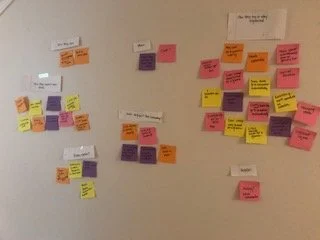
Affinity Mapping
I synthesized research findings into an affinity map to:
Identify behavioral patterns
Clarify user needs
Define required platform tools
This process enabled me to:
Prioritize features
Structure workflows
Establish a scalable information architecture
The visualization helped align product decisions with real user goals rather than feature requests alone.
Information Architecture
Using research insights, I designed an IA that balanced three competing needs:
Patient simplicity — frictionless survey completion
Pharmaceutical insights — rich aggregated data
Compliance requirements — strict separation of identity and metadata
The resulting structure separated:
Personal data (protected)
Analytical metadata (accessible)
Campaign configuration tools (administrative)

Design Process
Early Wireframes (collaborative sketching)
I began with hand-drawn wireframes to:
Encourage rapid iteration
Facilitate collaboration with the Product Manager
Capture brainstorming feedback in real time
This low-barrier approach accelerated decision-making before moving digital.


Lo-Fi Wireframes
After validating workflows, I translated concepts into Sketch:
Defined screen hierarchy
Established interaction patterns
Built initial campaign-creation flows
The focus was clarity and logical progression rather than visual polish.
And then I was able to start putting screens in Sketch.


Outcome
Before hi-fidelity prototyping and usability testing began, Engaged Media was acquired by Aptus Health, concluding the project.
However, the work established:
A validated product direction
MVP feature prioritization
Scalable information architecture
Foundational workflows for campaign creation and patient participation
Next Steps (planned)
Had the project continued, next phases included:
High-fidelity wireframes
Interactive prototype development
Usability testing with pharmaceutical users
Iteration on the survey builder experience
Validation of patient completion flow
The ultimate goal was a seamless end-to-end experience enabling companies to launch campaigns easily while maintaining a low-friction patient experience.
Impact & Key Learnings
Designing within healthcare requires balancing usability with regulatory constraints.
Early research prevents exponential scope growth.
Structuring data is often more impactful than adding features.
Testing assumptions with real users early clarified both patient and enterprise needs.